


Home → Blog
From Pulpit to Podcast: How One Sermon Becomes 30 Days of Content
Author: David Nsikak | Published: January 4, 2026 | Category: Sermon Multiplier | 8 min read
Let me walk you through something that changed how I approach ministry.
Last month, I preached a sermon on Romans 12:2—”Do not be conformed to this world, but be transformed by the renewal of your mind.” Standard passage. Classic text. The kind of sermon most pastors have preached multiple times.
I spent about 14 hours preparing it. Studied the Greek. Researched the cultural context. Developed illustrations. Crafted applications. Delivered it on Sunday to about 150 people.
And here’s what happened next: That single sermon generated 32 pieces of content over the following month, reaching more than 3,000 people across five different platforms—without me creating anything new from scratch.
Let me show you exactly how.
The Foundation: Understanding What You Already Have
Before we dive into the multiplication process, you need to recognize what’s actually sitting in your typical sermon. Most pastors don’t realize the wealth of content they’ve already created.
A standard 30-35 minute sermon typically contains:
3-5 major points, each substantial enough to stand alone as individual content pieces
Multiple Scripture references beyond your main text, each deserving deeper exploration
2-4 illustrations or stories that connect biblical truth to real life
Practical applications for different life situations and audiences
Thought-provoking questions that could fuel discussions and reflections
Theological insights that took you hours of study to uncover
Cultural observations that bridge ancient text and modern life.
That’s not one piece of content. That’s a content goldmine. You just need the extraction process.
The Multiplication Framework: Six Core Content Streams
When I applied the Romans 12:2 sermon to my multiplication system, I created content for six different streams. Let me show you what came from just one sermon point—the idea that transformation happens through “renewal of your mind.”
Stream 1: Social Media Content (Quote Graphics & Short Posts)
From that single point about mind renewal, I created:
Quote Graphic 1: “You can’t transform your life by thinking the same thoughts. Transformation requires renewed thinking.” (Posted Monday on Instagram and Facebook)
Quote Graphic 2: “What you feed your mind determines the direction of your life. Choose your inputs carefully.” (Posted Wednesday on Instagram and Twitter/X)
Short-form post (Tuesday on LinkedIn): “I used to think spiritual growth was about trying harder. Then I discovered Romans 12:2—it’s not about effort, but about what you allow to shape your thinking. The voices you listen to, the content you consume, the conversations you engage in—they’re either conforming you to the world or transforming you into Christ’s image. What’s shaping your mind this week?”
Result: Three distinct social media pieces from one sermon point, posted across multiple platforms, each sparking engagement and comments.
Stream 2: Email Devotional Series
I took the mind renewal concept and created a 5-day email devotional series:
- Day 1: “What Does It Mean to Renew Your Mind?” (Unpacking the Greek word for “renewal”)
- Day 2: “The Battle for Your Thoughts” (How our culture fights for mental real estate)
- Day 3: “Practical Steps to Mind Renewal” (Specific, actionable practices)
- Day 4: “What to Stop Consuming” (Identifying toxic mental inputs)
- Day 5: “The Long Game of Transformation” (Why this is a journey, not a quick fix)
Each email was 250-300 words—brief, focused, and actionable. Total writing time: about 90 minutes, because I was expanding on content I’d already created for the sermon.
Result: Five days of meaningful inbox presence, keeping biblical truth front-and-center throughout the week.
Stream 3: Blog Content
The second major point of my sermon became a full blog post: “Why Trying Harder Won’t Transform You (And What Will).”
The blog post took my 5-minute sermon point and expanded it to a 1,200-word article with:
- Deeper theological explanation
- Additional Scripture references I’d researched but didn’t have time to include on Sunday
- Extended illustrations
- Practical application steps
- Discussion questions at the end
Total writing time: About 2 hours, but again, I was building on content I’d already created. The research was done. The structure was there. I was just expanding and formatting for a different medium.
Result: Evergreen content that continues to attract Google search traffic and provides value long after Sunday.
Stream 4: Short-Form Video Content
I took one of my sermon illustrations—a story about how GPS navigation requires both knowing your destination AND being willing to change course when needed—and turned it into three 60-90 second video clips:
Video 1: The full illustration (pulled directly from the sermon recording)
Video 2: A “talking head” version where I re-told the story more conversationally for social media
Video 3: A text-overlay version with B-roll footage, using the same story but formatted for silent viewing.
These went to Instagram Reels, YouTube Shorts, Facebook, and TikTok.
Result: Video content that reached people who would never listen to a full sermon, with one clip getting shared 47 times.
Stream 5: Podcast Episodes
My podcast, “The Content Pastor,” uses a behind-the-scenes format where I walk through my sermon preparation and content multiplication process. From that Romans 12:2 sermon, I created two podcast episodes:
Episode 1: “How I Prepared This Week’s Sermon on Transformation” (15 minutes discussing my study process, interesting discoveries, and why I structured the sermon the way I did)
Episode 2: “Turning One Sermon Into 30+ Content Pieces: A Real-Time Walkthrough” (20 minutes showing exactly what I’m showing you here)
These weren’t scripted productions. I just turned on the microphone and talked through my process. Total recording and editing time: About 90 minutes for both episodes.
Result: Podcast content that serves other pastors while also giving my congregation insight into sermon preparation.
Stream 6: Discussion and Engagement Tools
I created resources designed to extend the sermon’s impact through conversation:
Small Group Discussion Guide: Six questions based on the sermon, with Scripture references and space for reflection (1-page PDF)
Family Dinner Questions: Age-appropriate questions parents could use to discuss the sermon with their kids at home
Workplace Application Card: Pocket-sized reference showing how to apply “mind renewal” in a work context
These tools didn’t just extend my sermon—they multiplied it through other people’s voices as small groups, families, and individuals engaged with the same biblical content throughout the week.

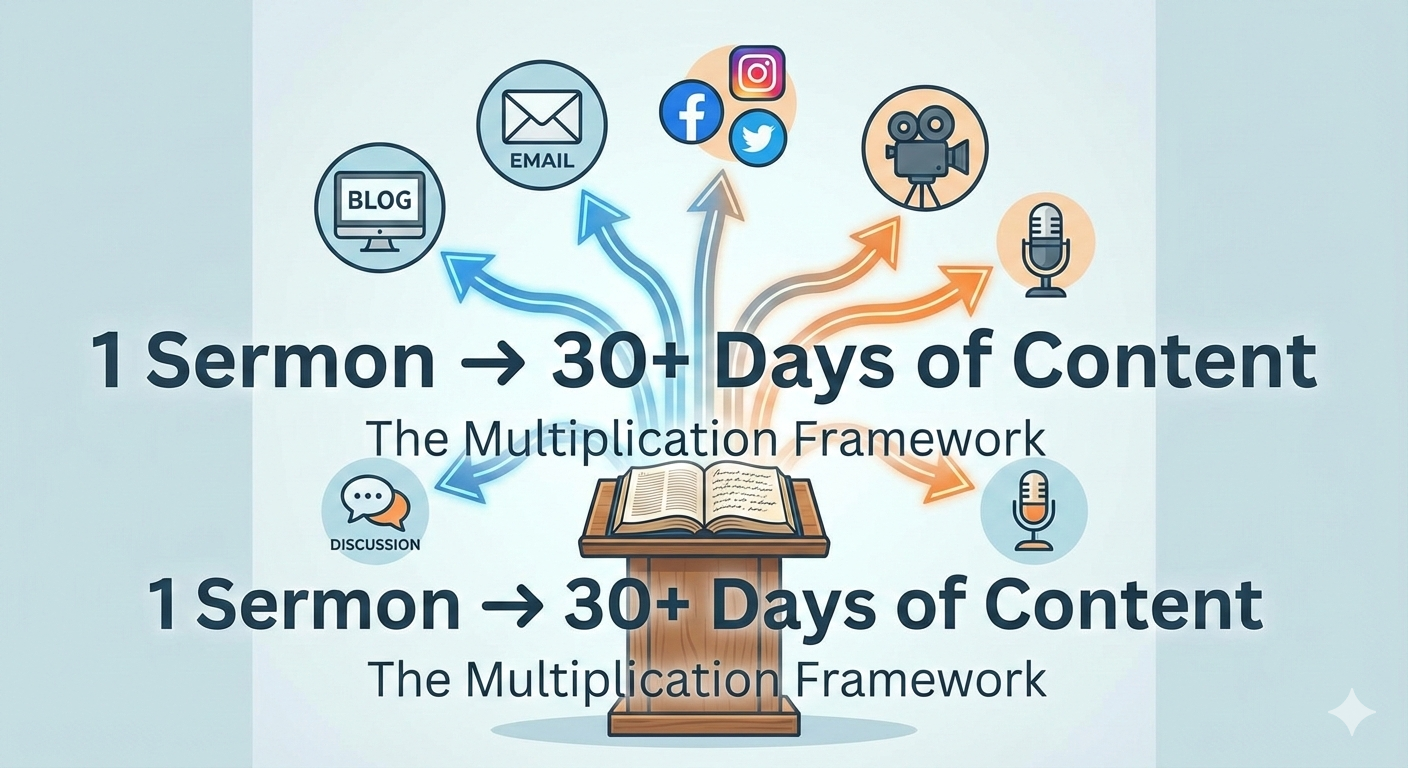
The Sermon Multiplier framework: One sermon becomes 15+ content pieces
The Weekly Workflow: How This Actually Works
You might be thinking: “This sounds like a lot of work.”:
Let me show you my actual time investment for that Romans 12:2 sermon multiplication:
Sunday after church: 30 minutes pulling key quotes and identifying which sermon points would work best for which platforms
Monday morning: 45 minutes creating the social media graphics and scheduling posts for the week
Tuesday morning: 90 minutes writing the 5-day email devotional series
Wednesday morning: 2 hours writing and formatting the blog post
Thursday morning: 60 minutes recording and editing the two podcast episodes
Friday morning: 45 minutes creating the discussion guides and application tools
Total multiplication time: About 6 hours spread across the week.
Compare that to creating all this content from scratch: Easily 15-20 hours, plus the mental strain of coming up with entirely new material while also preparing for next Sunday’s sermon.
The multiplication approach isn’t just more efficient—it’s sustainable. I’m working from abundance (content I’ve already created) rather than scarcity (constant pressure to create something new).
The Compounding Effect: What Happens Over Time
- Here’s what most pastors miss: Content multiplication isn’t just about this week or this month. It’s about building a library of biblical teaching that continues to work for you.
That Romans 12:2 content I created? Three months later:
- The blog post ranks on Google’s first page for “how to renew your mind biblically”
- The email series has been repurposed into a downloadable devotional guide
- The social media graphics get re-shared regularly by followers
- The podcast episodes continue to get downloads from new listeners
- The discussion guides are being used by small groups I’ve never met
One sermon. Multiplied once. Continuing to bear fruit months later.
- 52 blog posts (one per week)
- 260+ social media posts (5+ per week)
- 260 email devotionals (5 per week)
- 100+ short video clips
- 100+ podcast episodes
- 52 discussion guides
That’s not overwhelming content creation. That’s strategic multiplication of the content you’re already creating every single week through your sermon preparation.

The Beauty of Working Smarter
I spent years working harder—creating fresh content for every platform, scrambling for social media posts, wondering why I was exhausted.
Then I realized: I wasn’t lacking content. I was lacking a system to multiply it.
The sermon is your core content engine. Everything else flows from it. You’re not creating new material—you’re translating the same biblical truth into different formats for different platforms and audiences.
Your congregation needs to hear it multiple times in multiple ways. People outside your church need accessible entry points to biblical teaching. And you need a sustainable approach that doesn’t lead to burnout.
Content multiplication solves all three problems.

Your Next Step
What I’ve shown you here is just a glimpse of what’s possible. There are actually ten distinct ways to multiply a single sermon into 30+ days of strategic content across multiple platforms.
That’s exactly what I detail in “The Sermon Multiplier: 10 Ways to Transform One Sermon Into 30 Days of Content.”
This free guide gives you:
- The complete framework for all ten multiplication methods
- Platform-specific strategies and formatting tips
- Time-saving workflows and batch-creation processes
- Real examples and templates you can use immediately
- The mindset shifts that make multiplication sustainable
Download “The Sermon Multiplier” free guide here and discover how your next sermon can fuel a month of meaningful ministry impact.
You’re already creating gold every week. Now it’s time to multiply it.
Get Your Free Sermon Multiplication Guide
Discover the exact framework to turn ONE sermon into 15+ pieces of content. This step-by-step guide shows you how to build a content ecosystem that extends your ministry impact all week long.
Ready to Transform Your Sermon Into a Content Ecosystem?
Stop letting your sermons die after Sunday. Download our free “Sermon Multiplier Framework” and discover the exact system to turn one sermon into 15+ pieces of high-impact content.

The Path Forward
I made all three of these mistakes for years. I knew I should be doing more with my sermons, but I didn’t have a system. I posted sporadically on social media because I felt like I should, not because I had a strategy. And I burned myself out trying to create fresh content for every platform while sitting on years of unused sermon material.
Everything changed when I developed a systematic approach to sermon multiplication—a process that takes one sermon and strategically transforms it into 30 days of content across multiple platforms.
That’s exactly what I share in “The Sermon Multiplier: 10 Ways to Transform One Sermon Into 30 Days of Content.”
It’s a free guide that shows you:
- How to extract maximum value from every sermon without extra prep time
- The exact framework for turning one message into a month of strategic content
- Platform-specific strategies for blogs, emails, social media, and more
- Time-saving workflows that make multiplication sustainable
- Real examples you can implement immediately
Download “The Sermon Multiplier” free guide here and stop making these three costly mistakes with your sermon content.
Your sermons are too valuable to use just once. Your preparation time is too precious to waste. And the people who need to hear biblical truth throughout the week are waiting for you to multiply what you’re already creating.
Let’s fix these mistakes together.
Start Multiplying Your Sermons Today
Don’t let another Sunday sermon go to waste. Get our comprehensive “Sermon Multiplier Toolkit” with templates, checklists, and step-by-step guides to build your content ecosystem.
Inside you’ll get:
– The complete Sermon-to-Content framework
– 15+ content templates ready to use
– Weekly planning checklist
– Content calendar template
– Email sequence examples
No spam. Unsubscribe anytime. Just practical ministry content.

About David Nsikak
David Nsikak has over 20 years of pastoral ministry experience, specializing in New Creation theology. Through The Sermon Multiplier, he helps pastors transform their sermons into comprehensive content ecosystems that extend ministry impact beyond Sunday morning.
David is also the founder of New Creation Coaching and hosts The Content Pastor podcast, where he shares practical strategies for building sustainable ministry content systems.
Continue Learning
Explore more strategies to multiply your ministry impact
